

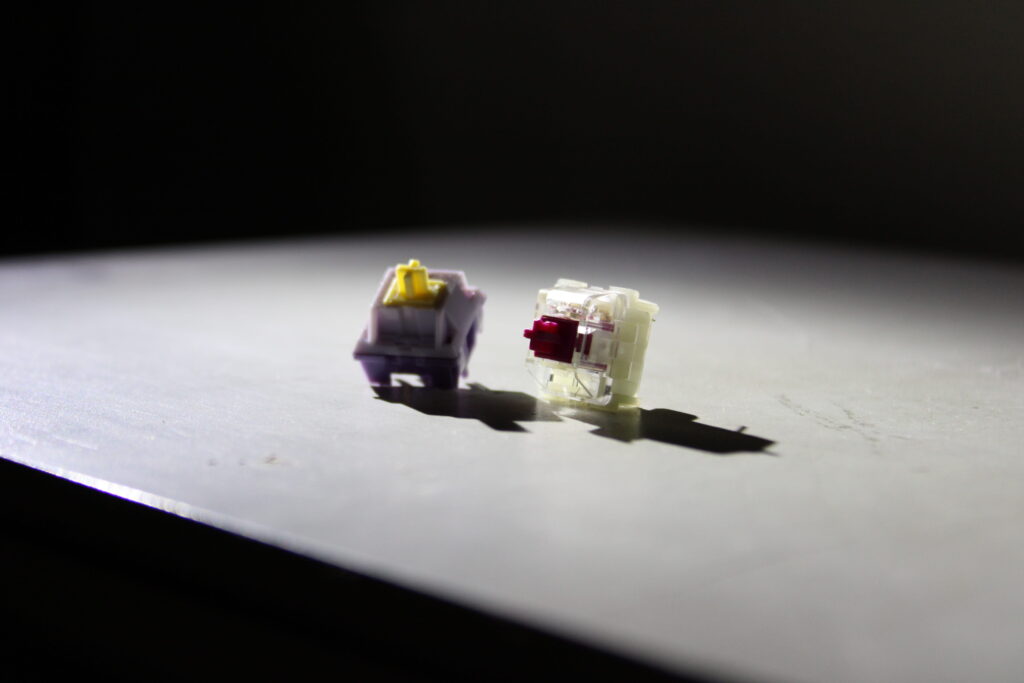
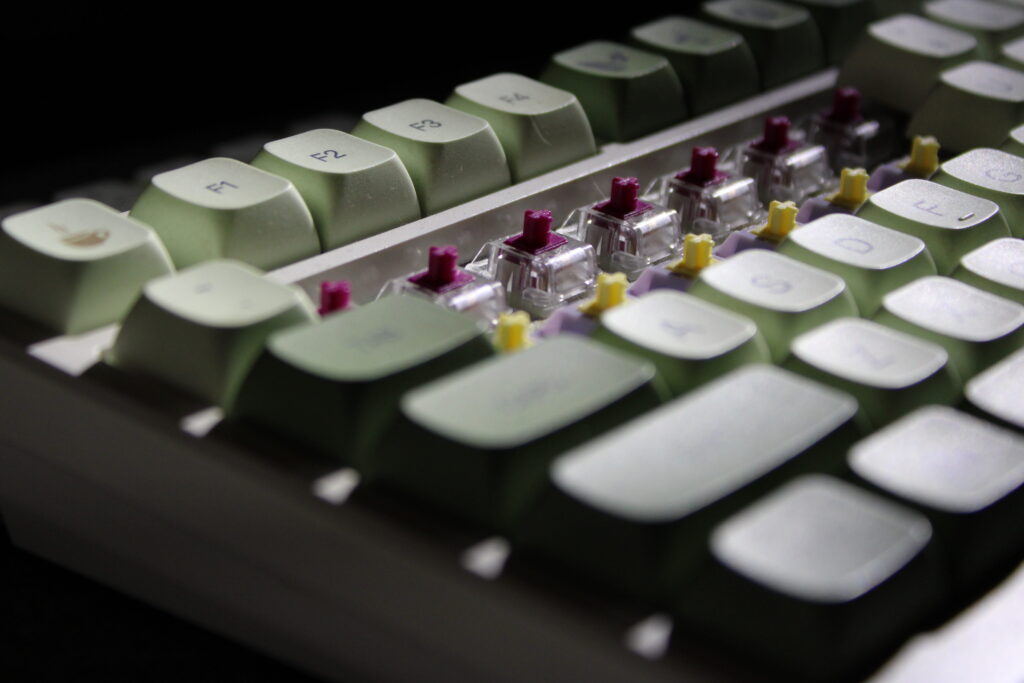
My indulgence in the intricacies of custom mechanical keyboards is a product of nothing but boredom. Starting with an old keyboard with Outemu Blue switches, I moved on to the Monsgeek MG75W. But one thing that remained unchanged was the switches: the Akko CS Lavender Purples.
Sadly enough, two years down the line, the Lavender Purples are all but usable. They are under the weather with constant problems with double-clicking and hit registers. That left me with no option but to put them to rest, providing me with an opportunity. One that allowed me to correct the mistake I made two years ago: picking tactiles over linears.
As of publishing this article, I have spent three days with the KTT Hyacinths and the KTT Wine Reds. After hours of gaming, content writing, and taking a couple of online tests, I am impressed. Let’s talk about these switches and my transition to linear switches from tactiles.
Switch Specifications
Mechanical keyboard switches are products that cannot be measured in terms of quality. You can measure frame rates for computer components, or battery life for a laptop or a phone. However, there is no such numeric evaluation when it comes to mechanical switches; it is totally down to the user’s personal preference.
Regardless, I believe it is good to take a look at the specifications, since they can give you a preliminary, albeit vague idea of how these linear switches might be.
Smoothness of the Switches
Let’s get down to what truly matters. Both switches are linear, from the same brand, but they do have some differences.
In terms of pure smoothness, the Hyacinths win over the Wine Reds. That said, when you bring the switches close to your ears, you can notice some minor scratchiness. This is very common with unlubed switches, like the ones in discussion. The Wine Reds, on the other hand, are not too scratchy. In fact, both switches are incredibly smooth and nice to type with. But the Hyacinths take the crown when it comes to smoothness.
But we must remember that some scratchiness persists when unlubed. The only way to get rid of that, of course, is to spend some time at the lubing station. I have not gotten around to lubing these switches yet. However, my online research suggests that both switches can get mesmerisingly smooth when lubed. I look forward to having more time to lube my linears and experiencing the joy of typing with lubed switches.
Typing Experience & Feel
What about the typing experience? To give you a good idea, let’s go to the table. As you can see, both switches have the same bottom-out force. But in reality, the Wine Reds feel significantly lighter compared to the Hyacinths. Let’s figure out why.
Taking a closer look, we can observe that the Wine Reds have a 12.5% greater travel distance. However, it has the same actuation force as the Hyacinths. As a result, the same amount of force causes the Wine Red stem to go further down than the Hyacinth stem. Thus, the Hyacinths feel somewhat heavier and more snappy.
Different Mounting Systems
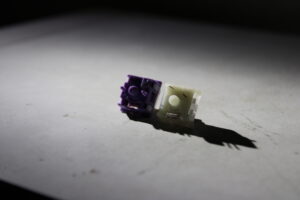
The Hyacinths have a 5-pin mounting system, an upgrade from the 3-pin Wine Reds. This gives the Hyacinths more stability in general. On top of that, it gives users the freedom to go plateless.
However, I did not expect the 5-pin switches to have this tight a fit. With the 3-pin Red Wines and Lavender Purples, taking the switches out is but a breeze. But moving on to the Hyacinths, it is more of a struggle. I have to wiggle the switch back and forth and struggle a little bit to take it out without any damage. Nevertheless, I believe I will get used to it with time.
The Eye-Candy Factor
Let’s be honest, looks don’t matter when the switches are covered by keycaps anyway. However, we must keep in mind that there are people who use transparent keycaps or care about them for no apparent reason. And how can they not? Keyboard switches look so cute nowadays, you might mistake them for candies.
The KTT Wine Reds, albeit being incredibly simple in looks, are very aesthetically pleasing. A clear top housing, an opaque white bottom housing, and a magenta stem, and it looks splendid. Nothing too exceptional, nothing over the top, but minimalism at its finest. But it’s a different story when it comes to the Hyacinths.
Yellow stem and purple housing – a combination I have never seen in any switch other than the Hyacinths. KTT clearly decided to try something new with their new switch, named after a flower. Does it look appealing? It sure does. The top housing is pale purple, a minor contrast from the bottom housing with a darker tone. The yellow stem perfectly complements the purples in this case.
One subtle touch I appreciate is the minimal branding. Just a faint engraving. In fact, I initially missed the engraving on the KTT Hyacinths. This is a stark contrast with other companies going all-in with the company name on top housing.
Switch Assembly
The Hyacinths have a reinforced interlocking rail system to attach the top housing to the bottom one. In contrast, the Wine Reds use the Kailh system. This is something to keep in mind when purchasing a switch opener. Both of these switches are reasonably tight, so filming is deemed unnecessary.
Switching over from Tactile Switches
Do you know why I picked tactiles two years ago? Because I presumed my habituation with clicky Outemu Blues would translate better to tactiles. After the switches showed up at my door, I immediately realized those switches were not what I expected. The tactile bump was much more pronounced than anticipated.
I later had the opportunity to try out some linear switches at the studio. It was clear – I should have gotten linears. Two years later, I have had the opportunity to correct my old mistake. So, how did I do this time?
I am satisfied with the new switches. In terms of adaptation, it was effortless. However, on extremely rare occasions, I will miss a click. The lack of a bump means there is no tactile sensation when a hit is registered. So sometimes, I might not push the stem deep enough. Aside from that, the experience is fabulous.
Sound
When I first purchased the Monsgeek MG75W, I was not quite satisfied with the sound. No amount of modification gave me the desired sound profile; the thocc seemed like a far cry. One switch replacement later, I am satisfied with the acoustics. Turns out, the Lavender Purples were the real culprit behind that clack. The sound profile of the Wine Reds has a slightly higher pitch compared to the Hyacinths. However, both switches sound deeper than their Akko CS predecessors. Here is a sound test of the Hyacinths:
I have only ordered a handful of Wine Reds for the numbers row and punctuation keys. Therefore, I apologise for not being able to record a proper sound test with them.
Verdict
Both the KTT Hyacinths and the KTT Wine Reds came out to me as smooth and cost-effective switches. Redditors report that the KTT Hyacinths are smoother than the Gateron Milky Yellows. However, I am unable to confirm this claim, since I have not tried the Gaterons in a long time. Nevertheless, the KTT Hyacinths are amazing switches for the price. I can safely recommend them to anybody looking for linears if these switches fit your budget.
The KTT Wine Reds are gems at a budget. I did not expect a switch this cheap to be this smooth and sound this good. If it is your first time with mechanical switches, you might want to give it a shot. I cannot, however, compare it to the Leobog Graywoods since I have never used them.
I will conclude this article by stating that I am satisfied with the switches. My stance will remain unchanged as long as the switches keep supporting me.